

CenTex Woodland Advises Bastrop Landowners That They Have Until April 2027 to Finish Approved Wildfire Grant Work
News originally published by
EIN Presswire
A CenTex Woodland Co. forestry mulcher works a rural Central Texas property. Brush and understory have been ground into mulch around trees and an outbuilding, leaving no slash piles behind.
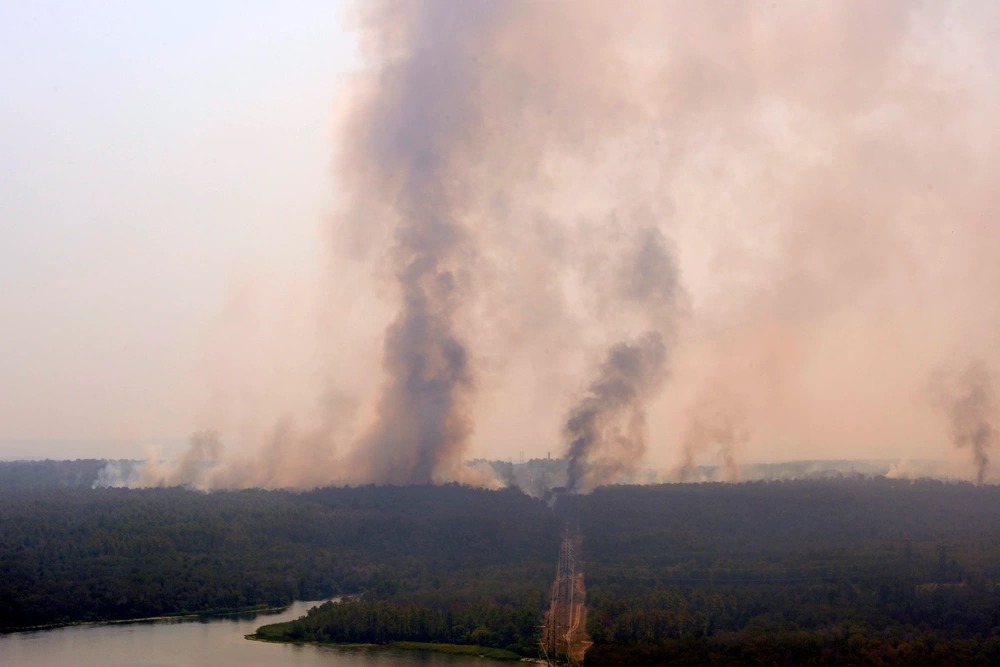
Smoke rises over forest during the 2011 Bastrop County Complex fire, which burned about 32,400 acres and destroyed more than 1,600 homes. It remains a reference point for wildfire mitigation in Bastrop County

Understory removed and mulched beneath an oak stand. Clearing the vegetation between the ground and the canopy reduces ladder fuels and opens spacing between trees.

Brush and ground-level growth mulched in place beneath mature oaks. The large trees stay, and the fuel layer underneath them is reduced.

A mulched lane cleared through cedar and oak gives vehicles room to move across the property, including access to areas that were blocked by brush.
Approved projects must pass pre-inspection first; CenTex Woodland explains steps, limits and fuel reduction for Bastrop acreage.
CenTex Woodland, a land management company based in Lexington, Texas, that provides forestry mulching, selective thinning, brush removal, defensible space clearing, and fuel break work for rural property owners in Bastrop County and surrounding Central Texas communities, is sharing information about the program’s requirements so that acreage owners, rural homeowners, and recreational property owners understand what the remaining timeline involves. CenTex Woodland does not administer the grant and is not affiliated with Texas A&M Forest Service. Grant approvals, inspections, and reimbursements are handled solely by the agency, and program questions should be directed to Texas A&M Forest Service.
The Mechanical Fuel Reduction Grant is a cost-share reimbursement program for private Texas landowners, funded through the USDA Forest Service and administered by Texas A&M Forest Service. Its stated purpose is to reduce the risk of home loss to wildfire through accepted mechanical fuel reduction practices. Eligible practices create defensible space or fuel breaks using hand tools, chainsaws, chippers, and forestry mulchers, also known as masticators. Eligibility is determined by county and community, and Bastrop County has been listed as a partially eligible county, meaning landowners should confirm their property’s status on the agency’s eligibility map rather than assume county-wide coverage.
What the April 2027 Deadline Means
Under the program’s published terms, the contractor hired by an approved landowner has until the end of April 2027 to complete all approved work. If the full project is not finished by that point, the landowner can be reimbursed only for the acreage that was actually completed, and may apply again in a future cycle for the acreage that was missed.
The program also addresses what happens when a contractor declines the job or fails to finish on time. In that situation, the landowner may reapply in the following grant cycle, but only on the first occurrence. Texas A&M Forest Service states that failing to complete the work two years in a row results in automatic disqualification in the third cycle.
For landowners who have already received approval, the practical question is not whether the deadline is months away, but whether every required step can be completed in the correct order before it arrives. Pre-inspection scheduling, contractor availability, weather, ground conditions, and the post-inspection all have to fit inside the same window.
The Required Sequence From Approval to Reimbursement
The program follows a fixed sequence, and the order matters as much as the work itself.
The process begins with approval. Approved applicants received an approval letter with a W-9 tax form, a terms and conditions form, and a copy of the submitted application. For the current cycle, those documents were required to be signed and returned by email by Sept. 18, 2026.
The second step is the required pre-inspection. Once the agency receives all required documents, it contacts the landowner by email to schedule a pre-inspection with agency staff. During that visit, staff photograph the site, verify the project dimensions, and answer remaining questions. Work may not begin until the pre-inspection has been completed. Any work started before the pre-inspection is not eligible for reimbursement, and the program states that work completed before pre-inspections will not be accepted.
The third step is contractor work. The project must be performed by the contractor listed on the signed application. That contractor must not be affiliated with the landowner, and the landowner may not perform the work personally. Contractor changes are permitted only under extenuating circumstances and require agency approval, followed by a new signed application listing the updated contractor. Other changes are more restricted: once the acceptance letter and signed documents have been submitted, a landowner who wants to change the treatment method, project location, dimensions, or approved reimbursement amount must reapply in the next grant cycle.
The fourth step is the post-inspection. After the contractor finishes, the landowner contacts the agency to schedule a post-inspection, which calculates the treated acreage and verifies that the required dimensions were met in the approved location.
The final step is submitting paid invoices for reimbursement. Invoices must include the project address and county, a description of the work conducted, the acreage completed, and a balance shown as paid in full or zeroed out. According to the agency, reimbursements issued by direct deposit typically take three to four weeks, while mailed checks may take four to six weeks.
Reimbursement Limits and What They Cover
The program reimburses actual costs up to set per-acre limits that depend on the approved treatment type. Heavy equipment treatment, in which trees and vegetation are thinned or reduced with a forestry mulcher or other heavy equipment, is reimbursed at up to $2,000 per acre. Combination treatment, which uses hand tools along with a mulcher or other heavy equipment depending on site conditions, is reimbursed at up to $1,500 per acre. Hand-cutting treatment, which relies on hand tools such as shears, pole saws, and chainsaws, is reimbursed at up to $750 per acre.
The maximum total reimbursement is $20,000 per landowner. Each application may include only one treatment type, though landowners may submit multiple applications for different locations or treatment types as long as the treatment areas do not overlap.
The program is designed as cost-share assistance, and funds may not cover the entire cost of a project. Reimbursement is limited to the acreage or amount approved in the landowner’s acceptance letter, so work performed beyond the approved scope is not reimbursed. Reimbursable costs are limited to items on a contractor’s invoice that relate directly to creating defensible space, installing fuel breaks, or renting equipment used for that work. Equipment purchases are not reimbursable.
Treatment Standards Set by the Program
Texas A&M Forest Service has published specific standards that apply to all treatment options, and those standards are checked at post-inspection. Each treatment must be at least 66 feet wide. All resulting debris, including dead woody material, cut limbs, and brush, must be removed from the property or mechanically reduced. Mature native Texas trees that remain must have their lower branches pruned or reduced to limit ladder fuels.
Burning of any kind is not allowed and results in disqualification. The agency explains that debris burning is one of the leading causes of wildfires in Texas, and that it is not permitted under this program because of the short project timeframe, the time of year, and the proximity of many projects to populated areas.
Priority is given to defensible space within 0 to 100 feet of a home or structure, although treatments may extend up to 300 feet in all directions. Fuel breaks, which are linear areas of reduced vegetation, are typically at least 66 feet wide and are intended to slow wildfire progression and protect homes and structures.
Why Land That Looks Clean May Not Be Properly Treated
A recurring point CenTex Woodland makes to Bastrop County property owners is that a property can look tidy from the road and still carry significant wildfire fuel. Mowed grass, a cleared fence line, or a neatly kept yard does not necessarily address the vegetation that allows fire to move quickly and reach structures.
On many rural properties in the Bastrop area, the more serious conditions sit above or beneath what is easily seen. Cedar, the common Central Texas name for native junipers, contains volatile oils and can ignite readily even when it appears green. Beneath mature loblolly pine and cedar, layers of understory growth and accumulated dead material can connect the ground to the tree canopy. A property where those conditions sit near a home, barn, or shop may still carry meaningful risk regardless of how well the open areas are maintained.
Treatment that only removes visible brush can also leave behind new problems. Cut material left in piles, often called slash, can dry out and become a concentrated fuel source of its own. That is one reason the grant program requires debris to be removed or mechanically reduced, and why forestry mulching, which grinds vegetation in place, is commonly used for fuel reduction work.
Ladder Fuels, Vegetation Spacing, Debris, and Access
Several specific conditions determine whether a property has been treated effectively for wildfire risk rather than simply cleared for appearance.
Ladder fuels are the vertical chain of vegetation, from grasses to shrubs to low limbs, that allows a ground fire to climb into tree canopies. Texas A&M Forest Service notes that reducing this vertical continuity can slow wildfire spread and improve firefighter access. In practice, this typically involves removing understory growth beneath trees and raising the lower limbs of trees that remain.
Vegetation spacing addresses horizontal continuity. Dense, continuous stands of cedar or brush allow fire to move from plant to plant across a property. Selective thinning creates gaps between remaining trees and shrubs, which can reduce how quickly fire spreads and how intensely it burns.
Debris management is often overlooked. Dead timber, fallen limbs, and leftover cuttings add fuel to the ground layer. Under the grant, all debris must leave the property or be reduced to mulch or chips before reimbursement is issued.
Emergency access is a practical concern on rural acreage. Narrow driveways, overgrown access roads, and fence lines crowded by brush or low limbs can limit the ability of fire trucks and responders to reach a structure. Clearing access routes and the areas around gates is a common part of fuel reduction planning in Bastrop County.
Ongoing Maintenance After the Work Is Done
Fuel reduction is not a one-time event. Cedar, brush, and understory growth return over time, and fallen limbs and dead material continue to accumulate. A treated property that is not maintained can gradually return to its earlier condition.
CenTex Woodland notes that forestry mulching leaves a layer of ground cover that can help suppress regrowth, but the company also emphasizes that periodic follow-up is part of keeping a property in a lower-risk condition. Property owners are encouraged to revisit treated areas regularly, particularly the zone closest to structures.
No vegetation treatment makes a property fireproof. Fuel reduction is intended to reduce the conditions that allow fire to spread rapidly and burn intensely near homes and structures, and to give responders a better opportunity to protect them. Outcomes during any wildfire depend on many factors, including weather, wind, terrain, and the condition of surrounding properties.
Why the Issue Matters in Bastrop County
Wildfire risk in Bastrop County is well documented. In 2011, the Bastrop County Complex fire burned approximately 32,400 acres and destroyed more than 1,600 homes, according to a Texas A&M Forest Service report prepared for the Texas Parks and Wildlife Department. The county’s mix of Lost Pines loblolly forest, cedar encroachment, and homes built among unmanaged vegetation continues to shape how local landowners approach fire mitigation in Bastrop County.
Texas A&M Forest Service has also focused outreach on the area. As part of its 2026 grant outreach, the agency scheduled a public workshop on its fuel reduction and prescribed fire grant programs at a Bastrop County ESD No. 2 fire station in Bastrop in May 2026.
CenTex Woodland works on rural properties throughout Bastrop County, including areas near Bastrop, Elgin, and Smithville, as well as neighboring communities such as Giddings and La Grange. The company’s wildfire fuel reduction work includes defensible space creation around structures, underbrush and ladder fuel thinning, dead timber and debris removal, and firebreak and buffer zone establishment.
Looking Ahead to the June 2027 Application Period
Applications for the Mechanical Fuel Reduction Grant are currently closed. According to Texas A&M Forest Service, the next application period opens June 1, 2027. Landowners who did not apply in the current cycle, or who were not approved, cannot submit new applications until then.
The grant is competitive, and approval is not guaranteed, regardless of previous years’ outcomes. In the most recent cycle, applications were accepted online only. Applicants were required to complete every question, submit a map of the proposed project area showing property boundaries, treatment location, and dimensions over aerial imagery, and provide contractor information along with a cost estimate. The agency evaluates applications using a scoring matrix that considers factors such as designation as a Firewise USA site, problematic fuel types, burn probability, the number of homes protected, creation of defensible space, and alignment with Community Wildfire Protection Plans.
Eligible counties are set by the federal funding source and may change from year to year, so landowners planning for the next cycle should review the eligibility map and program details when the 2027 period is announced. Program information is available from Texas A&M Forest Service at tfsweb.tamu.edu.
For landowners who want to understand their property’s fuel conditions before the next application period, CenTex Woodland conducts on-site property walks and provides written estimates. An on-site assessment can help identify where ladder fuels, dense cedar, debris accumulation, and access limitations are concentrated relative to homes and outbuildings.
Approved landowners in the current cycle should confirm that their required documents are complete, verify that their pre-inspection has been completed or scheduled, and coordinate timing with the contractor named on their signed application so that work is finished and documented before the end of April 2027.
About CenTex Woodland
CenTex Woodland is a locally owned and operated land management company based at 2158 Co Rd 333 in Lexington, Texas. The company was founded on more than 15 years of hands-on ranch and property management experience in Central Texas. CenTex Woodland provides forestry mulching, wildfire fuel reduction, cedar clearing, brush removal, fence line clearing, right-of-way clearing, habitat restoration, land clearing, pasture reclamation, and residential demolition for rural landowners, agricultural property owners, and recreational property owners. The company serves Lexington, Bastrop County, Lee County, Milam County, Burleson County, and surrounding rural communities in Central Texas. Its equipment includes an excavator, skid steers with mulcher heads, a dedicated forestry mulcher, and tractors with specialized implements, and the company is fully insured.
For more information, visit https://centexwoodland.com/ or call (512) 635-2320.
Michael Savoy
CenTex Woodland
+1 (512) 635-2320
mike@centexwoodland.com
Visit us on social media:
Facebook
Legal Disclaimer:
EIN Presswire provides this news content "as is" without warranty of any kind. We do not accept any responsibility or liability for the accuracy, content, images, videos, licenses, completeness, legality, or reliability of the information contained in this article. If you have any complaints or copyright issues related to this article, kindly contact the author above.
