

Inkwater Advances 'Last-Meter Positioning' Technology for a GPS-Denied World
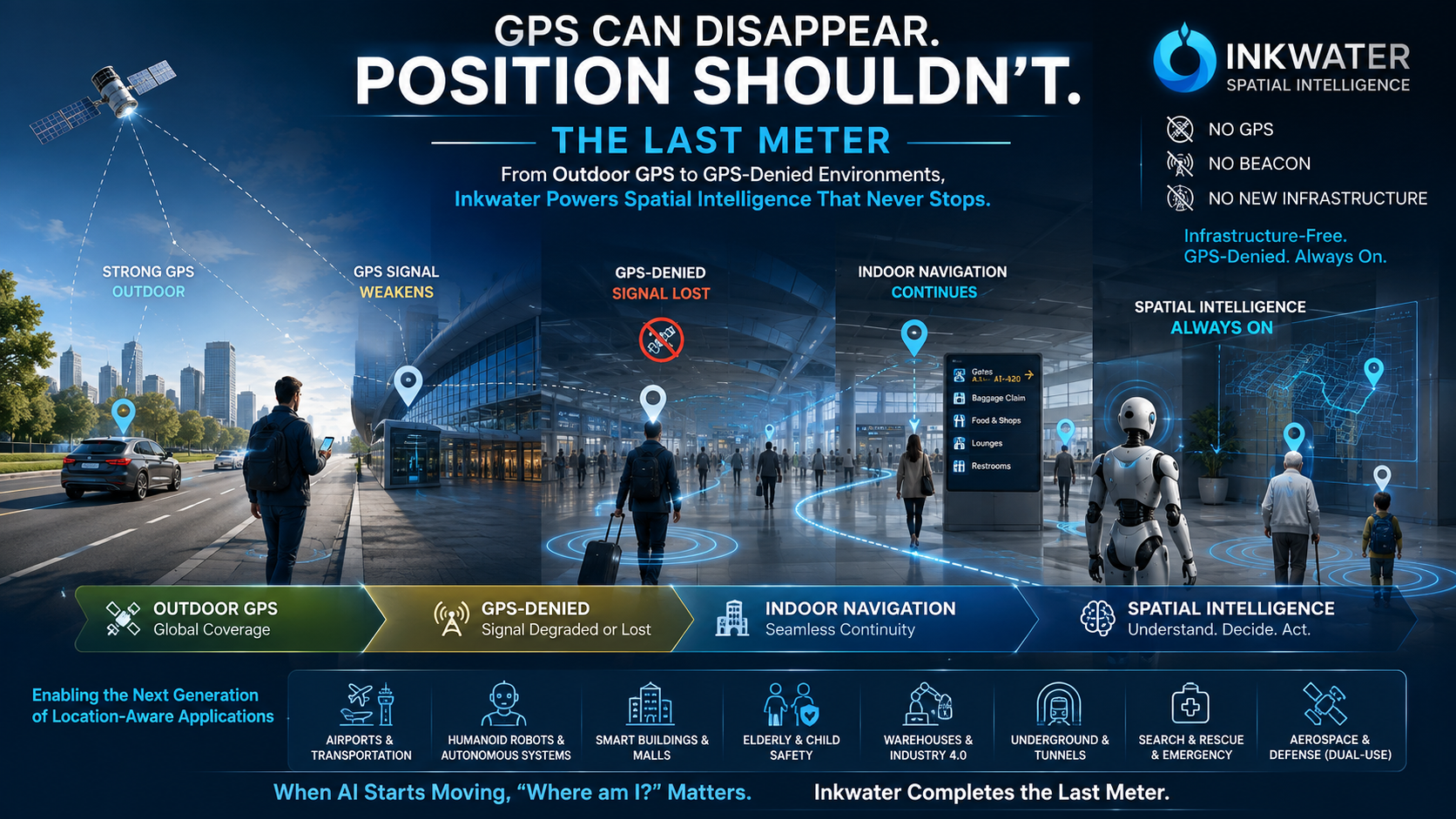
Inkwater Last-Meter Positioning – GPS-Denied Spatial Intelligence
Infrastructure-free, self-optimizing positioning requires no beacons or other hardware; underlying technology has been deployed at Singapore Changi Airport
Inkwater Holding Inc. (OTCMKTS:INKS)
DE, UNITED STATES, August 20, 2026 /EINPresswire.com/ -- **Inkwater Holding Inc. (“Inkwater” or the “Company”)** today announced an expansion of its technology strategy into next-generation positioning, navigation and Spatial Intelligence, focusing on one of the most persistent challenges in the global navigation industry:
**When GPS disappears, how do people and machines continue to know where they are?**
Inkwater refers to this challenge as the **“Last Meter” of positioning** — the missing positioning layer between outdoor satellite navigation and indoor or other GPS-denied environments.
GPS and GNSS have transformed outdoor navigation worldwide. But when people, vehicles or machines enter airports, shopping centers, hospitals, factories, underground parking structures, tunnels, transportation hubs or large buildings, satellite signals can rapidly deteriorate or disappear altogether.
Traditional indoor positioning solutions often attempt to address this gap through Bluetooth beacons, UWB anchors or other dedicated positioning infrastructure. Wireless fingerprinting approaches may also require extensive manual site surveys, mapping and periodic collection of signal fingerprints — labor-intensive processes that can increase deployment and maintenance costs while limiting scalability.
Inkwater’s next-generation positioning strategy takes a fundamentally different approach:
**No GPS. No Beacon. No New Infrastructure.**
The technology is designed to provide positioning and navigation in GPS-denied environments by utilizing wireless signals already present in the environment together with sensing capabilities available on endpoint devices — without requiring venues to deploy dedicated beacons or install new positioning hardware.
More importantly, the architecture is designed to be **self-optimizing**, allowing positioning performance to improve as the system accumulates additional real-world usage and environmental data.
The underlying technology has already been deployed in complex, large-scale environments including **Singapore Changi Airport, Tokyo Station and major commercial complexes in China**, demonstrating its potential in transportation hubs and other environments where satellite positioning is limited or unavailable.
## “GPS Solved Global Positioning. We Want to Complete the Last Meter.”
**I-Fa Chang, Chairman of Inkwater Holding Inc.,** said:
> “GPS changed the way humanity understands location, but it did not complete the last meter of positioning. When a person, a vehicle or a robot enters an environment where GPS can no longer provide reliable coverage, location awareness should not disappear with the satellite signal.”
> “The opportunity we see is to extend positioning naturally from the outdoor world into GPS-denied environments without requiring every venue to install beacons or rebuild dedicated positioning infrastructure. If this capability can scale, it represents much more than indoor navigation. It could become an important foundation for Spatial Intelligence in the era of Physical AI.”
Inkwater believes the future of positioning will evolve from conventional outdoor GPS navigation toward continuous spatial awareness capable of understanding where people and machines are within the three-dimensional physical world.
## From Global Digital Maps to the Last Meter Inside a Building
Global technology companies such as **Google and Apple** have built massive digital mapping and location-services ecosystems capable of guiding users across cities, countries and much of the world.
Yet when a user drives from a roadway into an underground parking structure, walks from outdoors into an airport, or enters a large shopping complex, positioning accuracy and continuity may still be constrained by satellite signal availability.
In cities with elevated highways, underground roads and multi-level transportation systems, knowing a user’s X-Y coordinates may not be enough. Determining the correct **Z-axis — the vertical level or floor** — can be equally important.
Inkwater believes the next generation of location services is not simply about getting a user to a building.
It is about **continuing to guide that user to the correct location inside the building.**
The Company views the evolution as a continuous positioning architecture:
**Outdoor GPS → GPS-Denied Positioning → Indoor Navigation → Spatial Intelligence**
Inkwater believes this continuity could represent an important next stage for the global location-services industry.
## Physical AI Must First Answer: “Where Am I?”
The opportunity extends far beyond smartphone navigation.
As **NVIDIA** continues to advance the Physical AI and robotics ecosystem, and companies such as **Tesla** develop intelligent mobility, autonomous systems and humanoid robots, artificial intelligence is rapidly moving beyond screens and into the physical world.
Humanoid robots and autonomous machines may increasingly operate inside factories, hospitals, airports, warehouses, shopping centers, office buildings, underground facilities and homes.
Regardless of how sophisticated an AI system becomes, however, a mobile machine still needs to answer one fundamental question:
**Where am I?**
Only after understanding its own position can a machine determine:
**Where should I go next?**
A robot entering a building cannot simply lose spatial awareness because GPS disappears.
Inkwater believes reliable **GPS-denied positioning** could become a foundational capability for Physical AI — providing machines with continuous location awareness as they transition between outdoor and indoor environments.
This same capability may ultimately extend to autonomous vehicles, drones, low-altitude mobility platforms and other intelligent machines operating in environments where conventional satellite positioning may be unavailable, obstructed or unreliable.
## GPS Can Disappear. People Shouldn’t.
The technology may also have significant applications in personal safety.
Parents today can use smartphones, smartwatches and GPS-enabled devices to monitor the location of children. Families can similarly use location technologies to support the safety of older adults.
But when someone enters a shopping center, underground parking facility, station, airport or another environment with poor satellite reception, conventional GPS-based location awareness may decline significantly.
This creates a practical problem:
**The moment someone most needs to be found may be the same moment GPS can no longer find them.**
If positioning can continue from outdoor GPS environments into indoor and GPS-denied spaces, it could enable a more continuous form of **Location Safety** for children, older adults and others requiring location-based safety support.
Inkwater’s objective is straightforward:
**GPS can disappear. Location awareness should not.**
## Infrastructure-Free and Designed to Improve With Use
One of the most important aspects of Inkwater’s positioning strategy is not only what the technology can do, but what it is designed **not** to require.
Traditional high-precision indoor positioning may depend on Bluetooth beacons, UWB anchors, RFID or other dedicated infrastructure.
Wi-Fi fingerprinting approaches can also require significant manual signal collection, map association and recurring recalibration as physical and radio-frequency environments change over time.
As a result, deploying indoor positioning across each new airport, hospital, factory, commercial complex or transportation hub can require substantial implementation and ongoing maintenance.
Inkwater’s architecture instead focuses on utilizing wireless signals already present in the environment — including existing connectivity signals — together with sensing capabilities already available on endpoint devices.
The goal is to achieve positioning without adding a dedicated positioning hardware layer to every venue.
The architecture is also designed to reduce dependence on recurring manual fingerprint collection. As additional real-world positioning observations become available, the system can use that information to continuously optimize positioning performance.
In simple terms:
**The more the system is used, the more opportunity it has to improve.**
Inkwater believes this combination of **infrastructure-free deployment and self-optimization** could materially reduce barriers to scaling indoor and GPS-denied positioning.
## Dr. Jiangsen Tian: The Last Meter Could Be an Important Breakthrough for Physical AI
**Dr. Jiangsen Tian**, Chief AI Scientist of **Yushan AI**, previously served as Vice President of **Microsoft Research Asia** and has extensive experience in the productization and commercialization of artificial intelligence and advanced research technologies.
During his time at Microsoft Research Asia, Dr. Tian was exposed to technology initiatives involving indoor navigation, IoT, robotics and augmented reality.
After reviewing the Last-Meter Positioning technology being advanced by Inkwater, Dr. Tian noted that the historical challenge of bringing indoor positioning to mass-market scale has involved more than positioning accuracy alone. Deployment costs, infrastructure requirements and the ability to maintain accuracy over time have also been significant barriers.
Dr. Tian said:
> “During my years at Microsoft Research Asia, I was exposed to indoor navigation and related technology initiatives, so I understand how difficult this problem is. Accuracy is only one part of the challenge. For indoor positioning to reach large-scale adoption, the industry must also solve the deployment and infrastructure problem.”
> “What excites me most about the Last-Meter technology Inkwater is advancing is that it does not require every venue to redeploy beacons or install dedicated positioning hardware. Just as importantly, positioning error can be continuously optimized, allowing the system to improve as it is used. From both a technology and commercialization perspective, I believe this represents a very important breakthrough.”
Dr. Tian added:
> “As AI moves from screens into robots, vehicles and the physical world, ‘Where am I?’ becomes a fundamental question. AI may understand language, images and its environment, but if an autonomous system does not understand its own location, it cannot fully understand its relationship with the physical world. I believe the convergence of Last-Meter Positioning and AI deserves to be viewed through the broader lens of Physical AI and Spatial Intelligence.”
Inkwater also intends to explore potential synergies between **Yushan AI’s AI and Edge AI capabilities** and the Company’s broader Spatial Intelligence strategy.
The Company’s longer-term vision is to enable intelligent devices to progressively answer three fundamental questions:
**Where am I?**
**What is around me?**
**What should I do next?**
## From Technology Breakthrough to Global Commercialization
Inkwater believes the Last Meter represents not only a technical challenge, but also a potentially significant global commercialization opportunity.
The Company’s technology, product and business teams are working to advance Spatial Intelligence and GPS-denied positioning across markets including global mapping and location services, robotics, intelligent transportation, airports, healthcare, smart buildings, industrial environments, low-altitude mobility and other large-scale infrastructure applications.
**Allen Chiu, Head of Business Development at Inkwater,** said:
> “We do not see this simply as an indoor positioning market. We see it as the Last Meter that remains unresolved after GPS. From global mapping and location services to airports, large buildings, humanoid robots and autonomous systems, truly scalable positioning technology cannot require every venue to deploy an expensive new layer of dedicated infrastructure.”
> “Our job is to transform a breakthrough positioning capability into products and commercial services that can be deployed at scale, while working with partners across industries to explore entirely new use cases.”
## Beyond Indoor Positioning: Spatial Intelligence
Inkwater does not view Last-Meter Positioning as merely an indoor navigation solution.
Potential applications extend across global mapping and location services, airports and transportation hubs, healthcare and senior care, smart factories, shopping centers, warehousing and logistics, underground parking structures and tunnels, humanoid robots, autonomous mobile systems, intelligent vehicles, child and elderly safety, search and rescue, emergency response, drones, low-altitude mobility and aerospace applications operating in GPS-denied environments.
Certain underlying positioning capabilities may also have **dual-use potential**, including applications in unmanned systems, aerospace, emergency response and defense-related environments.
Any future application involving regulated markets will be evaluated in accordance with applicable laws, regulations and export-control requirements.
## From Google and Apple to NVIDIA, Tesla and SpaceX: AI Is Entering the Physical World
From the global mapping and location-services ecosystems represented by **Google and Apple**, to the Physical AI and robotics ecosystem being advanced by **NVIDIA**, the intelligent mobility and autonomous systems being developed by companies such as **Tesla**, and the next generation of aerospace represented by companies such as **SpaceX**, a common trend is emerging:
**AI is leaving the screen and entering the physical world.**
When AI starts moving, it needs more than compute, models and vision.
It also needs to know where it is.
Inkwater believes:
**When AI starts moving, “Where am I?” matters.**
And when GPS can no longer answer that question, a new positioning layer is needed to complete the **Last Meter**.
Inkwater plans to continue integrating artificial intelligence, wireless sensing, positioning, navigation and Spatial Intelligence technologies while exploring commercialization and strategic collaboration opportunities across global mapping and location services, Physical AI, intelligent mobility, robotics, smart infrastructure, low-altitude applications, aerospace and other industries.
## About Inkwater Holding Inc.
**Inkwater Holding Inc.** is a technology company focused on the commercialization of artificial intelligence, intelligent devices and emerging technologies. The Company is expanding its technology strategy into next-generation positioning, navigation and Spatial Intelligence, exploring opportunities created by the convergence of artificial intelligence and the physical world.
## Forward-Looking Statements
This press release contains forward-looking statements, including, but not limited to, statements concerning the potential capabilities, performance, applications, commercialization, market opportunities, strategic collaborations and future development of Inkwater’s positioning, navigation, artificial intelligence and Spatial Intelligence technologies.
Forward-looking statements are based on the Company’s current expectations, estimates and assumptions and involve risks and uncertainties that could cause actual results to differ materially from those expressed or implied. References to potential applications, markets and future capabilities do not constitute assurances that such applications or commercialization will be successfully developed or achieved.
References in this press release to third-party companies, brands and institutions, including **Google, Apple, Microsoft, Microsoft Research Asia, NVIDIA, Tesla, SpaceX, Singapore Changi Airport, Tokyo Station** and other third parties, are included solely to describe professional backgrounds, industry developments, market trends, technology-use contexts or prior deployment environments. Such references **do not represent or imply any partnership, endorsement, investment, commercial relationship or other affiliation between Inkwater and any such company or institution unless separately announced by the Company.**
Readers are cautioned not to place undue reliance on forward-looking statements. Except as required by applicable law, Inkwater undertakes no obligation to update or revise any forward-looking statement.
I-fa Chang
Inkwater Holding Inc.
+1 425-365-9666
Ivan@inkstonecapital.com
Visit us on social media:
LinkedIn
Facebook
Other
Legal Disclaimer:
EIN Presswire provides this news content "as is" without warranty of any kind. We do not accept any responsibility or liability for the accuracy, content, images, videos, licenses, completeness, legality, or reliability of the information contained in this article. If you have any complaints or copyright issues related to this article, kindly contact the author above.
