

Autonomous, Edge-Native Drone Swarms Unveiled by Tashi
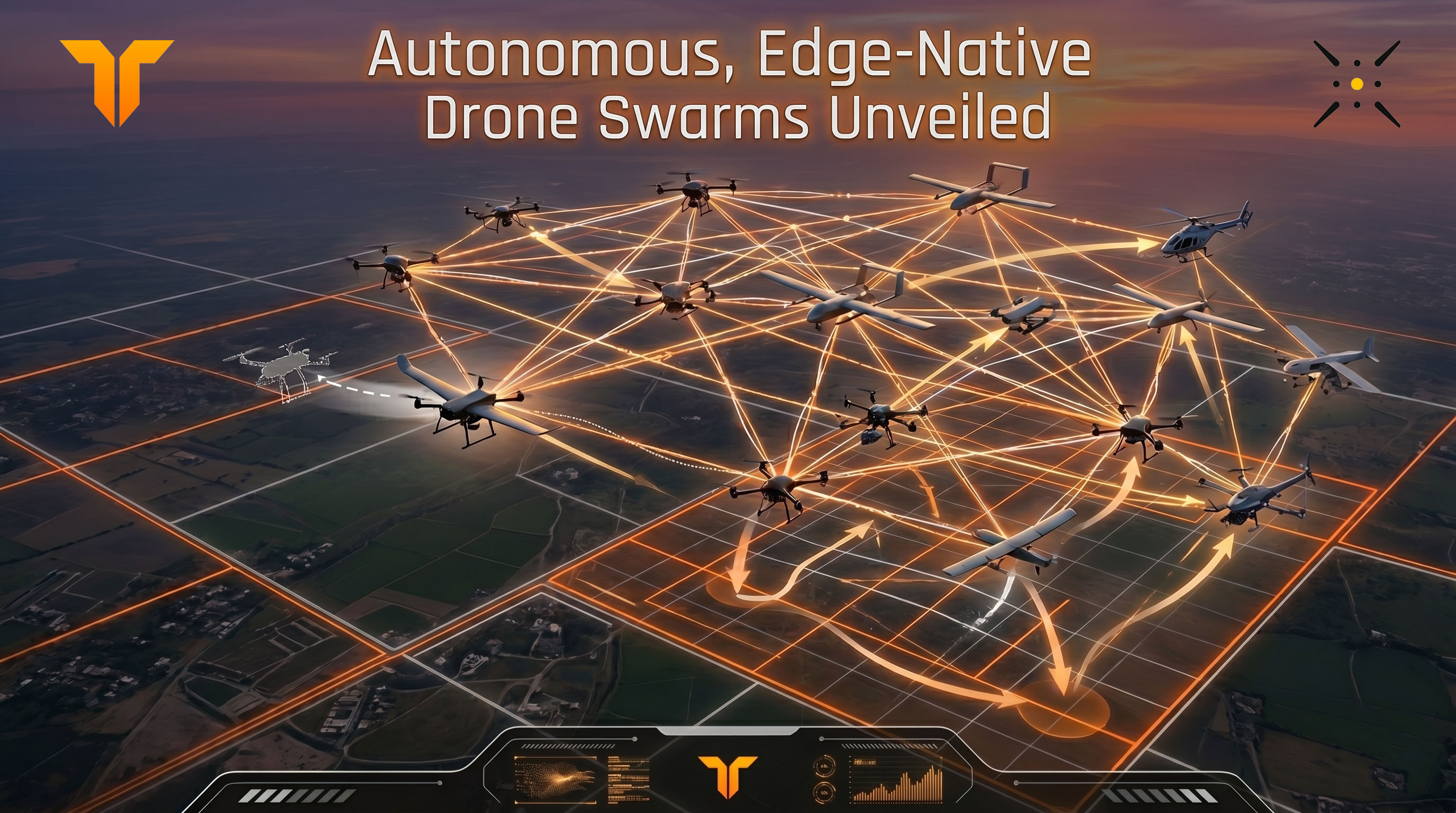
Tashi Unveils Autonomous Edge Native Drone Swarms
Live exercise shows autonomous drones sharing targets and re-re-tasking without a central controller, as governments accelerate investment in autonomous swarms.
SINGAPORE, June 23, 2026 /EINPresswire.com/ -- Tashi Network, a leader in autonomous coordination, and DroneVerse, a major Indian UAV and defence‑solutions provider, today successfully completed a live drone swarm field trial in the Delhi region, demonstrating how a decentralised mesh keeps missions going even when individual drones drop out, batteries run low, or links back to base are intermittent.
Over the past year, global defence budgets have tilted decisively toward massed, networked uncrewed systems. The Pentagon’s proposed $54.6 billion autonomous warfare push, alongside enabling software, underscores how quickly AI-enabled operations are moving from concept to large-scale procurement. In contested airspace across the U.S., Europe, and Asia, keeping a swarm coherent has shifted from a research topic to an immediate operational requirement.
The joint exercise reflects this broader shift, as armed forces move from one-off drones to coordinated swarms that reconnoitre, strike, and re-task autonomously. Recent Indian force modernization programs highlight the critical need for dynamic mesh communication, ensuring the swarm completes the job and returns safely even if units drop out, a requirement this trial explicitly mirrored.
A live-fire rehearsal for autonomous teaming
First, multirole tactical drones executed a coordinated find–fix–finish mission over a predefined perimeter. Surveillance platforms fanned out to search the grid and, on detecting a target area, reconnaissance units bypassed central ground control stations, communicating directly with payload platforms over Tashi’s Vertex edge mesh to coordinate exact strike coordinates following human authorization. All target confirmation, tasking, and local deconfliction happened entirely peer-to-peer.
Second, during a simulated search-and-rescue mission, a surveillance swarm automatically partitioned an operational ground sector into equal slices. Mid-mission, one aircraft returned to base on low battery. Rather than leaving a tactical blind spot, the remaining drones instantly renegotiated the flight plan at the edge, autonomously re-routing to absorb the abandoned sector while maintaining a unified, shared source of truth.
“Most so‑called autonomous systems fall apart the moment the link to their master is jammed, drops, or lags,” said Amar Bedi, CEO of Tashi Network. “In these trials we proved the opposite. Once you have a shared source of truth at the edge, the swarm doesn’t ask for permission to keep the mission alive. Humans stay in the loop for intent, but machines handle the millisecond‑by‑millisecond choreography. We are moving from remote‑controlled fleets to thinking swarms.”
From brittle links to resilient meshes
Today’s conventional operations heavily rely on single ground control stations, brittle point-to-point links, or siloed vendor stacks, presenting a dangerous single point of failure in contested terrain. Tashi’s Vertex coordination fabric completely inverts this paradigm. Every participating drone operates as an equal peer on a shared local Directed Acyclic Graph (DAG) mesh, continuously exchanging state, intent, and tasking. If a platform is lost, the remaining units already hold the global plan and deterministically redistribute the workload.
“For us, this wasn’t just a flight test, it was a systems test,” said Pawan Khatri, Founder & CEO of DroneVerse. “Our customers in defence and internal security don't just want more hardware, they want teams of drones that can think together across different vendors. Seeing our NDAA-compliant platforms self-organize, split a task, and seamlessly rebuild the mission when a unit heads home is exactly the capability frontline forces require. This builds on our recent AI-enabled autonomous deployments with Indian Army units, turning isolated drones into a resilient team.”
A milestone for autonomous infrastructure
Militaries are realizing that the real bottleneck in deploying swarms is not airframes, but the coordination infrastructure underneath them. From the U.S. Swarm Forge live-fire tests to international swarm experiments, the technical focus has shifted to the software layers that unify heterogeneous fleets.
Validating this edge-native capability in a skyrocketing drone market, where over USD 2 billion in new military drone orders are projected from domestic firms alone, proves infrastructure innovation can ride alongside national self-reliance. The partners plan to expand the testing program to larger formations, mixed payload configurations, and more complex mission profiles in the coming months.
“India doesn’t just need more drones in the sky, it needs smarter skies,” Amar added. “This trial is a vital step toward a future where autonomous systems can be trusted to share context, adapt on the fly, and finish the job, even when the network around them is falling apart.”
Irfan Khan
Tashi Network PTE. LTD.
irfan@tashi.network
Legal Disclaimer:
EIN Presswire provides this news content "as is" without warranty of any kind. We do not accept any responsibility or liability for the accuracy, content, images, videos, licenses, completeness, legality, or reliability of the information contained in this article. If you have any complaints or copyright issues related to this article, kindly contact the author above.
