

Get your daily news on business and economy
Provided by AGP
Philippines Computer-Aided Design (CAD) Market 2026-2034 | Size, Share, Price, Outlook
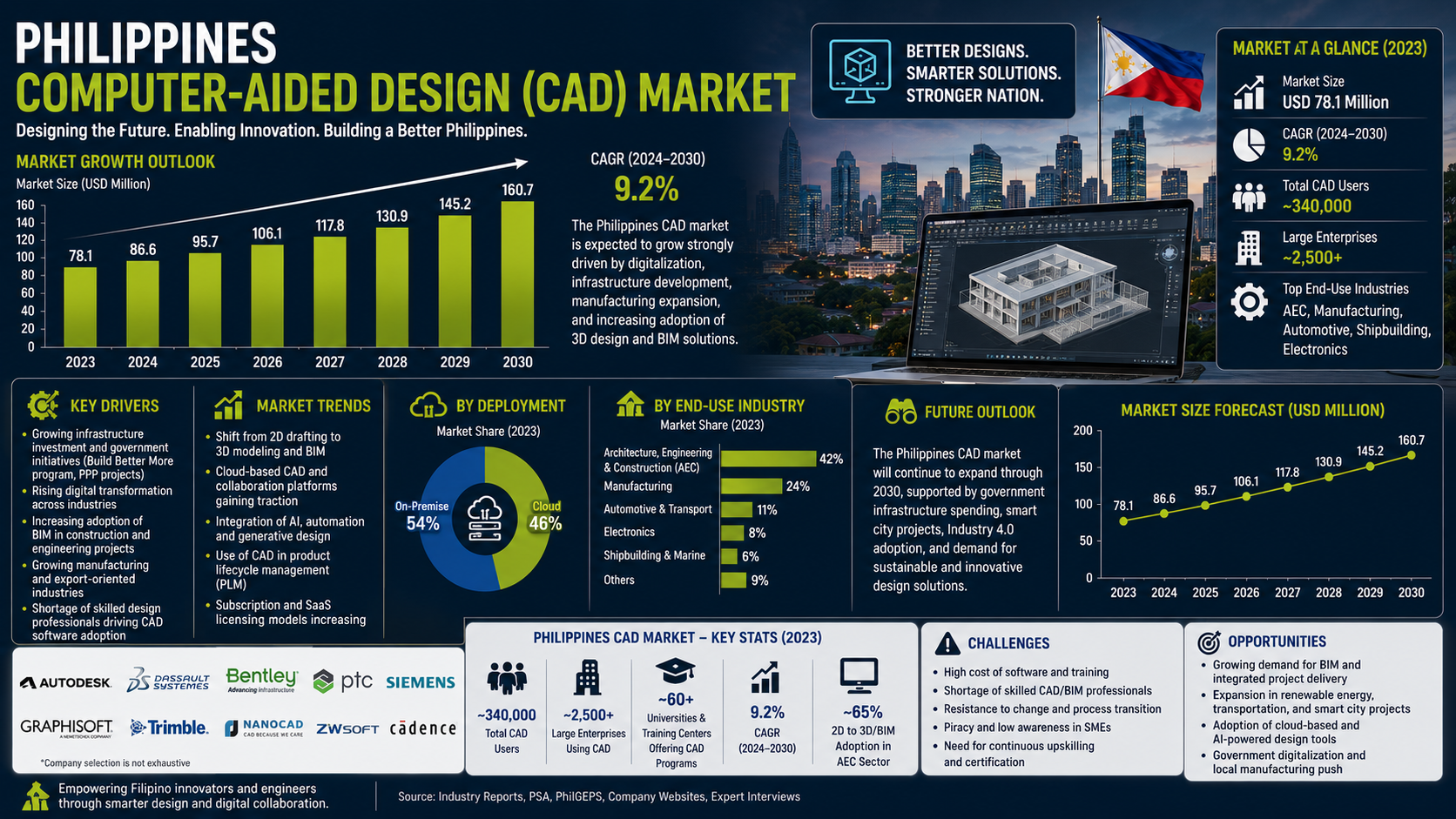
The Philippines computer-aided design (CAD) market size reached USD 59.19 Million in 2025 & is projected to reach USD 135.29 Million by 2034 at a CAGR of 9.62%.
PHILIPPINES, May 19, 2026 /EINPresswire.com/ --Market Overview:
The Philippines computer-aided design (CAD) market is experiencing robust growth, driven by accelerating digital transformation across architecture, engineering, and construction sectors, expanding adoption of cloud-based design platforms, and the government's sustained investment in national infrastructure modernization programs. The market reached USD 59.19 Million in 2025 and is projected to attain USD 135.29 Million by 2034, registering a compound annual growth rate (CAGR) of 9.62% during 2026-2034. The expansion is being fueled by rising building information modeling adoption across public and private construction projects, growing demand for 3D modeling and simulation tools in manufacturing and electronics industries, the proliferation of Industry 4.0 technologies driving digital prototyping requirements, increasing integration of generative AI capabilities into design workflows, expanding educational programs in engineering and architecture disciplines, and the convergence of CAD with additive manufacturing and reverse engineering applications across the Philippine industrial landscape.
Why is Hot Today Philippines Computer-Aided Design (CAD) Market?
The Philippines CAD market is attracting heightened attention as landmark government digitalization initiatives and rapid technological advancements are converging to reshape design and engineering workflows. The Philippine e-Governance Act (RA 12254), signed in September 2025, is mandating the digitalization of government transactions and infrastructure planning processes, creating substantial demand for CAD tools across public sector engineering and urban development projects. The Philippine construction market, valued at approximately USD 39.40 billion, is increasingly adopting BIM-integrated CAD platforms, with pioneering firms like DMCI Homes deploying dedicated BIM teams for large-scale residential developments. Meanwhile, global CAD vendors are embedding AI-powered generative design capabilities into their platforms, with tools that are reducing design iterations by up to 30% and enabling engineers to generate hundreds of optimized design alternatives from performance constraints.
Philippines Computer-Aided Design (CAD) Market Summary:
• Software is dominating as the largest component segment, driven by growing enterprise subscriptions for cloud-based CAD platforms that are enabling real-time collaboration, version control, and remote access capabilities for distributed design teams across the Philippine archipelago.
• Cloud-based deployment is emerging as the fastest-growing development model, as organizations are transitioning from perpetual license models to subscription-based cloud CAD solutions that are reducing upfront capital expenditure and enabling scalable access to advanced design tools.
• The civil and construction end-user segment is commanding significant market share, supported by the Philippines' robust infrastructure development pipeline and the increasing adoption of BIM-integrated CAD solutions for structural design, urban planning, and project lifecycle management.
• 3D CAD technology is registering accelerating adoption across manufacturing and engineering sectors, as three-dimensional modeling, simulation, and visualization capabilities are becoming essential for product development, prototyping, and digital twin applications in Philippine industries.
• The electrical and electronics end-user segment is experiencing strong growth as semiconductor packaging facilities, consumer electronics manufacturers, and PCB design houses across the Philippines are expanding their CAD tool investments to support increasingly complex circuit and component design requirements.
• Surface modeling and 3D printing applications are gaining traction as additive manufacturing adoption accelerates in the Philippines, with CAD platforms enabling the creation of complex geometries and customized designs for prototyping, tooling, and small-batch production across automotive and industrial equipment sectors.
• Luzon is commanding the largest regional share of CAD market revenue, anchored by Metro Manila's concentration of engineering firms, architectural practices, construction companies, IT service providers, and educational institutions producing a growing pipeline of design professionals.
Porter's Five Forces Analysis – Philippines CAD Market
Valued at USD 59.19 Million in 2025 and projected to reach USD 135.29 Million by 2034 (CAGR 9.62%), this is a fast-growing, digitalization-led market.
Bargaining Power of Suppliers – Moderate to High
• A few global software leaders — Autodesk (AutoCAD, Revit), Dassault Systèmes (SOLIDWORKS), Siemens, PTC, and Bentley Systems — anchor the supply side.
• The shift to subscription SaaS gives vendors recurring-revenue leverage, though cloud delivery is also lowering costs for local buyers.
Bargaining Power of Buyers – Moderate
• Cost-sensitive SMEs negotiate hard on licensing, yet cloud democratization is widening affordable access.
• Large infrastructure and electronics manufacturers seek tailored, localized solutions, encouraging vendor flexibility.
Threat of New Entrants – Moderate
• Cloud SaaS lowers entry barriers for niche developers, local resellers, and value-added integrators offering localized support and training.
• Strong incumbent brand equity and high R&D intensity still protect established vendors.
Threat of Substitutes – Low
• For precision engineering, BIM, and 3D design, CAD has few credible alternatives; legacy 2D/manual drafting persists but is steadily being displaced.
• AI-driven generative design is reinforcing CAD's indispensability rather than replacing it.
Competitive Rivalry – Moderate (Healthy, Growth-Led)
• Global vendors compete on functionality, AI features, and support, while local integrators differentiate via localization — a constructive, expanding ecosystem.
Key Growth Catalysts
• E-Governance Act (RA 12254), signed September 2025, accelerating nationwide digital transformation.
• DICT/NTC 5G rollout enabling bandwidth-heavy cloud CAD collaboration.
• Build Better More and a USD 39.40 Billion (2024) construction market driving BIM adoption — pioneered by developers like DMCI Homes (18 in-house BIM modelers).
Outlook: With BIM still at roughly one-third adoption, the Philippines offers substantial whitespace. Vendors investing in cloud, AI, training, and academic partnerships are best placed to capture the USD 135 Million opportunity.
Request for a sample report PDF: https://www.imarcgroup.com/philippines-computer-aided-design-market/requestsample
Market Trends and Insights:
• The transition from perpetual licensing to cloud-based subscription models is fundamentally reshaping CAD software procurement patterns, with Philippine enterprises increasingly favoring SaaS-based platforms that are offering lower entry costs, automatic updates, and collaborative design capabilities accessible from any location across the archipelago.
• Building information modeling integration is accelerating across the Philippine construction sector, with leading developers pioneering BIM adoption for large-scale residential and commercial projects, transitioning from traditional 2D drafting to comprehensive 3D model-based design that is enabling improved project coordination and cost estimation.
• The convergence of CAD with additive manufacturing technologies is creating new design possibilities, as Philippine manufacturers are leveraging advanced 3D modeling tools to produce complex geometries optimized for 3D printing processes, supporting rapid prototyping and custom fabrication across industrial and consumer product sectors.
• Industry 4.0 adoption is driving demand for integrated CAD-CAM-CAE platforms that are enabling Philippine manufacturing firms to establish digital threads connecting design, simulation, and production workflows, improving product quality and reducing time-to-market for locally manufactured goods.
• The growing emphasis on sustainable building design is increasing demand for CAD tools with energy modeling and environmental analysis capabilities, as Philippine architects and engineers are integrating performance simulation into the design process to comply with green building standards and optimize energy efficiency.
• Educational institutions across the Philippines are expanding CAD curriculum offerings and establishing industry partnerships with global software vendors, creating a growing talent pipeline of skilled design professionals while driving academic license adoption that is supporting long-term market penetration.
Market Growth Drivers:
Government Infrastructure Investment, Digital Transformation Mandates, and Urbanization
The Philippines CAD market is primarily driven by the government's sustained commitment to large-scale infrastructure development and digital transformation across public sector operations. The Build Better More program is sustaining a robust pipeline of transportation, energy, and urban development projects that are requiring advanced CAD and BIM tools for design, planning, and project management. The e-Governance Act (RA 12254) is mandating the digitalization of government transactions and planning processes, creating institutional demand for computer-aided design capabilities across government engineering departments and public works agencies. Rapid urbanization across Metro Manila and secondary cities is generating sustained demand for architectural and structural design services, compelling engineering firms to adopt modern CAD platforms that improve design accuracy and project delivery timelines.
Cloud Computing Adoption, Industry 4.0 Integration, and Manufacturing Modernization
The accelerating adoption of cloud computing infrastructure across the Philippines is enabling broader access to enterprise-grade CAD platforms that were previously limited to large organizations with significant IT budgets. Cloud-based CAD solutions are reducing deployment barriers by eliminating the need for high-performance local workstations, enabling small and medium-sized engineering firms to access advanced 3D modeling, simulation, and collaborative design tools through subscription-based models. Industry 4.0 technologies are driving demand for integrated digital design and manufacturing workflows, with Philippine electronics manufacturers, automotive component suppliers, and industrial equipment producers investing in CAD-CAM platforms that connect design intent with production execution.
BIM Adoption, Skilled Workforce Development, and Global Technology Vendor Expansion
The growing adoption of building information modeling across the Philippine architecture, engineering, and construction industry is serving as a critical growth catalyst for the CAD market, with pioneering firms demonstrating the productivity and coordination benefits of model-based design for complex building projects. Global CAD vendors are expanding their presence in the Philippine market through local distributor partnerships, educational licensing programs, and cloud platform accessibility, making advanced design tools available to a broader range of organizations. The expansion of engineering and architecture degree programs, combined with professional certification initiatives and vendor-sponsored training programs, is developing a skilled workforce pipeline that is supporting increased CAD adoption across design disciplines and industry verticals.
Browse the full report with TOC and list of figures: https://www.imarcgroup.com/philippines-computer-aided-design-market
Market Segmentation:
IMARC Group's research categorizes the Philippines computer-aided design (CAD) market as follows:
By Component:
• Software
• Services
By Development Model:
• Cloud
• On-Premises
By Application:
• 3D Printing
• Surface Modelling
• Reverse Engineering
• Drafting Detailing
• Assembly
• Others
By Technology:
• 2D
• 3D
By End User:
• Electrical & Electronics
• Automotive
• Civil & Construction
• Energy & Materials
• Industrial Equipment
• Media & Entertainment
• Others
By Region:
• Luzon
• Visayas
• Mindanao
Key Players:
The competitive landscape of the Philippines computer-aided design (CAD) market is characterized by the strong presence of global technology vendors operating through local distributor and reseller networks. Major players operating in the market include Autodesk Inc., Dassault Systemes SE, Siemens Digital Industries Software, PTC Inc., Bentley Systems Incorporated, Trimble Inc., Hexagon AB, ANSYS Inc., Nemetschek Group, and Graphisoft SE, among others. These companies are differentiating through cloud platform expansion, AI-powered generative design capabilities, industry-specific solutions for construction and manufacturing verticals, educational licensing programs, and strategic partnerships with local engineering firms and IT service providers to strengthen market penetration across the Philippine archipelago.
Recent News and Developments:
September 2025: The Philippine government signed the e-Governance Act (RA 12254) into law, mandating the digitalization of government transactions and public sector operations, creating significant institutional demand for CAD and BIM tools across government engineering and infrastructure planning departments.
March 2025: Siemens completed its acquisition of Altair Engineering for USD 10.6 billion, significantly expanding its simulation and digital twin capabilities and strengthening its comprehensive CAD-CAM-CAE portfolio available to Philippine manufacturing and engineering firms through its regional distribution network.
February 2025: Dassault Systemes acquired Contentserv to enhance its product lifecycle management and digital design ecosystem, broadening the range of integrated design-to-production solutions accessible to Philippine enterprises adopting cloud-based engineering platforms.
2025: Autodesk released significant AI-driven automation updates across its CAD platform portfolio, introducing capabilities that are reducing design iterations by up to 30% and enabling Philippine architects and engineers to accelerate project delivery through intelligent design assistance tools.
2025: PTC launched Creo 12 with advanced AI-driven generative design and thermal physics simulation capabilities, providing Philippine manufacturing firms with enhanced tools for topology optimization and performance-based design that are streamlining product development workflows.
November 2024: The 5th Philippine Construction Congress convened industry stakeholders to accelerate BIM adoption and digital transformation across the architecture, engineering, and construction sector, with discussions highlighting the transition toward BIM 6.0 integrating IoT and real-time energy performance monitoring.
Speak to an analyst for a customized sample report PDF: https://www.imarcgroup.com/request?type=report&id=44476&flag=C
Note: If you require any specific information that is not covered currently within the scope of the report, we will provide the same as a part of the customization.
Other Report by IMARC Group:
Philippines E-Commerce Market 2026: https://www.imarcgroup.com/philippines-e-commerce-market
Philippines Cybersecurity Market 2026: https://www.imarcgroup.com/philippines-cybersecurity-market
Philippines Subscription Box Market 2026: https://www.imarcgroup.com/philippines-subscription-box-market
Philippines Pro AV Market 2026: https://www.imarcgroup.com/philippines-pro-av-market
Philippines Data Center Chip Market 2026: https://www.imarcgroup.com/philippines-data-center-chip-market
About Us
IMARC Group is a global management consulting firm that helps the world's most ambitious changemakers to create a lasting impact. The company provides a comprehensive suite of market entry and expansion services. IMARC's offerings include thorough market assessment, feasibility studies, company incorporation assistance, factory setup support, regulatory approvals and licensing navigation, branding, marketing and sales strategies, and partner identification and procurement. From conducting thorough market research to assisting with factory establishment, IMARC Group is the trusted partner for businesses looking to establish a strong presence in international markets.
Contact Us
IMARC Group
134 N 4th St., Brooklyn, NY 11249, USA
Email: sales@imarcgroup.com
Tel. No.: (D) +91 120 433 0800
United States: +1-201-971-6302
Elena Anderson
IMARC Services Private Limited
+1 201-971-6302
email us here
Legal Disclaimer:
EIN Presswire provides this news content "as is" without warranty of any kind. We do not accept any responsibility or liability for the accuracy, content, images, videos, licenses, completeness, legality, or reliability of the information contained in this article. If you have any complaints or copyright issues related to this article, kindly contact the author above.
