

Get your daily news on business and economy
Provided by AGP
Philippines Animal Vaccines Market 2026-2034 | Veterinary Vaccine | Size, Share
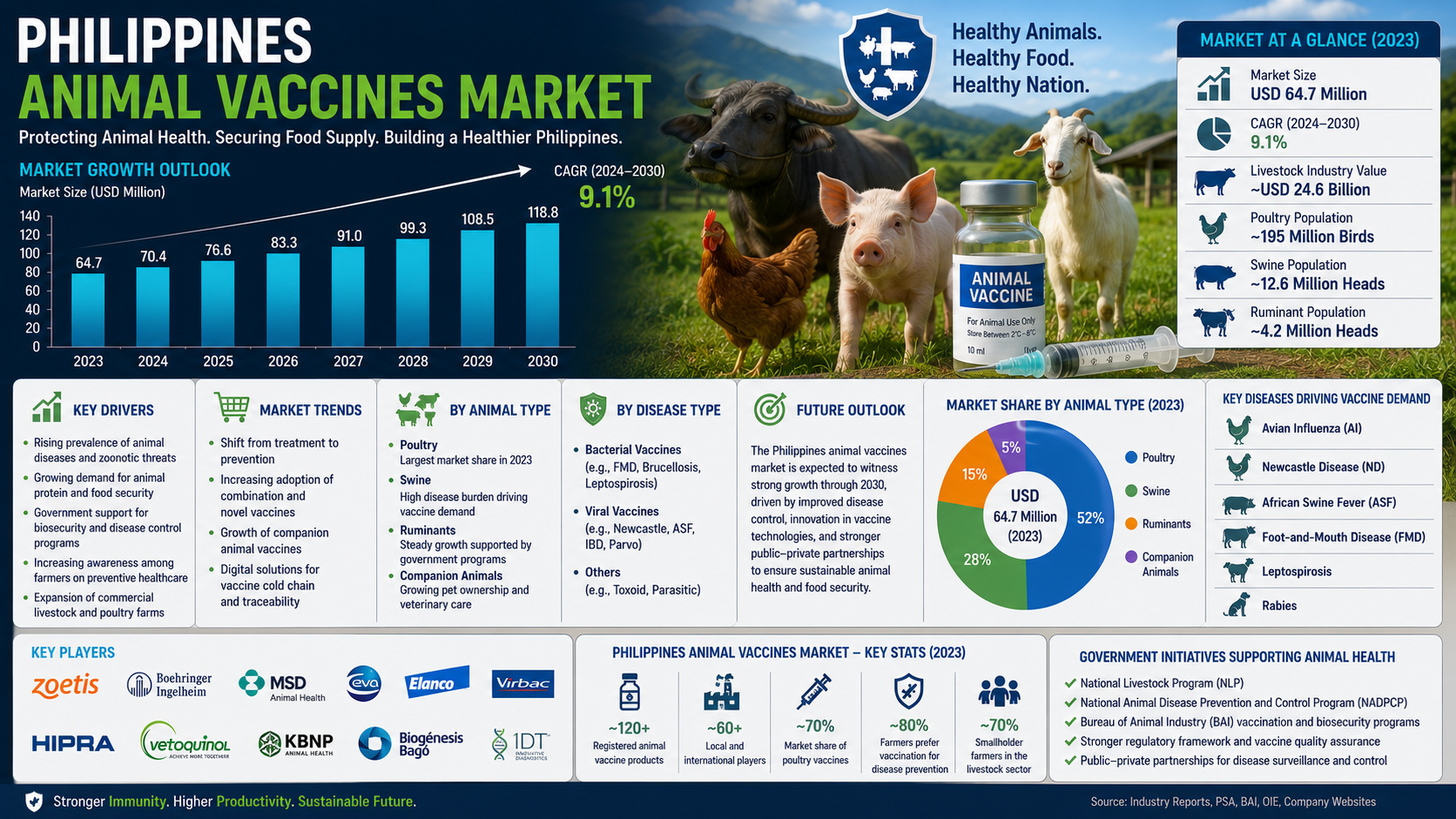
Philippines animal vaccines market size reached USD 304.62 Million in 2025 and is projected to reach USD 537.31 Million by 2034, at a CAGR of 6.51%. 2026-2034.
PHILIPPINES, May 19, 2026 /EINPresswire.com/ --Market Overview:
The Philippines animal vaccines market is experiencing robust growth, driven by government-led disease control and vaccination programs targeting transboundary animal diseases, rising pet adoption coupled with increased awareness about preventive veterinary care, and significant investments in domestic vaccine research and development infrastructure. The market reached USD 304.62 Million in 2025 and is projected to attain USD 537.31 Million by 2034, registering a compound annual growth rate (CAGR) of 6.51% during 2026-2034. The expansion is being fueled by the escalating threat of African swine fever and avian influenza necessitating comprehensive immunization campaigns, the expansion of commercial poultry and swine farming operations, growing biosecurity requirements across livestock production facilities, the establishment of domestic vaccine manufacturing capabilities through the Center for Transboundary Animal Diseases, increasing government funding for veterinary pharmaceutical innovation, and the rising demand for companion animal vaccines driven by pet humanization trends across urban Filipino households.
Why is Hot Today Philippines Animal Vaccines Market?
The Philippines animal vaccines market is commanding unprecedented attention as landmark government investments and disease control breakthroughs are transforming the national veterinary health landscape. The Department of Agriculture inaugurated the vaccine unit at the Center for Transboundary Animal Diseases in April 2025, establishing a state-of-the-art facility dedicated to developing vaccines against African swine fever, foot-and-mouth disease, and avian influenza, with PHP 151 million earmarked for a three-year vaccine development program. The government-regulated ASF vaccination programme has achieved remarkable progress, with nearly 500,000 pigs vaccinated and a 90% efficacy rate recorded in healthy animals. ASF-affected barangays have declined by 92% from 98 in late December 2025 to just 8 by mid-January 2026, signalling the effectiveness of coordinated vaccination and biosecurity measures across the Philippine swine industry.
Philippines Animal Vaccines Market Summary:
• Attenuated vaccines are commanding the largest product segment share, as live attenuated formulations are providing strong immune responses across poultry, swine, and cattle populations, supporting mass vaccination programs for diseases including Newcastle disease, infectious bronchitis, and classical swine fever.
• Livestock animals are dominating as the largest animal type segment, driven by the Philippines' substantial commercial poultry and swine farming industries that are requiring comprehensive vaccination protocols to protect against transboundary diseases and maintain production efficiency across large-scale operations.
• Intramuscular administration is leading the route of administration segment, as the method is providing reliable vaccine delivery and consistent immune responses across diverse animal species, supporting both mass vaccination campaigns in commercial farms and individual animal immunization in veterinary clinics.
• Companion animal vaccines are registering the fastest growth trajectory, driven by rising pet adoption rates among urban Filipino households, growing awareness of rabies prevention requirements, and increasing willingness among pet owners to invest in comprehensive preventive healthcare programs for dogs and cats.
• Recombinant and DNA vaccines are gaining significant attention as next-generation vaccine technologies, with ongoing research and development efforts targeting improved safety profiles, enhanced immunogenicity, and the ability to differentiate vaccinated animals from naturally infected populations in disease surveillance programs.
• The swine segment is experiencing heightened vaccine demand following the devastating impact of African swine fever outbreaks since 2019, with the government-led ASF vaccination programme expanding coverage and driving adoption of both imported and domestically developed vaccine solutions across commercial and backyard farming operations.
• Luzon is commanding the largest regional share of animal vaccines market revenue, supported by the concentration of commercial poultry and swine farming operations, the presence of major veterinary pharmaceutical distributors, advanced cold chain infrastructure, and proximity to government veterinary research institutions in Central Luzon.
Porter's Five Forces Analysis – Philippines Animal Vaccines Market
Valued at USD 304.62 Million in 2025 and projected to reach USD 537.31 Million by 2034 (CAGR 6.51%), this is a resilient, government-backed growth market.
Bargaining Power of Suppliers – Moderate to High
• A few global animal-health leaders — Zoetis, Boehringer Ingelheim, MSD Animal Health, Ceva, and Elanco — supply advanced vaccine technologies.
• Emerging local production is easing this: the DA's Center for Transboundary Animal Diseases (CenTrAD) vaccine unit (April 2025) and a PHP 151 Million three-year program with the first BSL-3 laboratory are building domestic capacity.
Bargaining Power of Buyers – Moderate
• Large commercial poultry and swine farms negotiate on volume, while government procurement for national disease programs commands standardized, bulk pricing.
• Rising pet humanization and preventive-care awareness steadily expand willing companion-animal buyers.
Threat of New Entrants – Low to Moderate
• High R&D intensity, BSL-grade facilities, and regulatory approval via the Bureau of Animal Industry (BAI) protect established players.
• Government R&D support and partnerships, however, open clear pathways for local manufacturers.
Threat of Substitutes – Low
• Vaccination has no real substitute for transboundary disease control; biosecurity and culling are complements, not replacements.
Competitive Rivalry – Moderate (Healthy, Innovation-Led)
• International firms compete on quality, species coverage, and technical support; local distributors differentiate via rural reach and government tie-ups.
Key Growth Catalysts
• ASF vaccine rollout under DA/BAI cut active infections to just 39 barangays by March 2025.
• WOAH FMD-free status sustains export competitiveness and herd protection.
• Rabies Awareness Month (March) drives recurring companion-animal demand.
Outlook: With strong government funding, expanding local manufacturing, and indispensable demand, the market offers a stable, opportunity-rich path toward the USD 537 Million milestone.
Request for a sample report PDF: https://www.imarcgroup.com/philippines-animal-vaccines-market/requestsample
Market Trends and Insights:
• The government-regulated African swine fever vaccination programme is achieving significant milestones, with expanding coverage across commercial and backyard swine farming operations and a dramatic 92% reduction in ASF-affected barangays, restoring confidence in the Philippine pork supply chain and driving sustained demand for ASF vaccine products.
• The establishment of domestic vaccine research and manufacturing capabilities through the Center for Transboundary Animal Diseases is marking a strategic shift toward indigenous vaccine production, with the facility targeting development of locally produced vaccines for ASF, avian influenza, and foot-and-mouth disease to reduce import dependence.
• The rising adoption of companion animals in urban Filipino households is driving growing demand for rabies, parvovirus, distemper, and feline vaccination protocols, supported by government-led free vaccination campaigns during annual Rabies Awareness Month celebrations and expanding veterinary clinic infrastructure.
• Multi-valent vaccine development is gaining traction as manufacturers are creating combination products that protect against multiple pathogens simultaneously, reducing injection frequency, lowering per-dose costs for farmers, and simplifying vaccination schedules for resource-constrained smallholder livestock operations.
• The commercial rollout of highly pathogenic avian influenza vaccines is strengthening biosecurity in the Philippine poultry sector, with enhanced vaccination protocols and disease monitoring systems supporting the growth and stability of the country's expanding commercial broiler and layer farming operations.
• Cold chain infrastructure modernization is improving vaccine distribution across the Philippine archipelago, with investments in temperature-controlled storage and transportation solutions ensuring vaccine potency and extending the reach of immunization programs to remote island communities and provincial farming regions.
Market Growth Drivers:
Government Disease Control Programs, Biosecurity Mandates, and Vaccination Funding
The Philippines animal vaccines market is primarily driven by the government's intensified investment in disease prevention infrastructure and comprehensive vaccination programs targeting transboundary animal diseases. The Department of Agriculture is implementing coordinated initiatives involving substantial funding allocations, emergency vaccine procurement procedures, and the establishment of disease monitoring systems utilizing zonation classification to enable targeted vaccine deployment. The inauguration of the Center for Transboundary Animal Diseases with PHP 151 million in dedicated vaccine development funding is signalling a long-term commitment to building domestic vaccine production capacity. Regulatory frameworks mandating biosecurity compliance across commercial farming operations are driving systematic vaccination adoption, while government-funded free vaccination campaigns for rabies and other zoonotic diseases are expanding immunization coverage across both livestock and companion animal populations.
Livestock Industry Expansion, Commercial Farming Growth, and Food Security Priorities
The expansion of commercial poultry and swine farming operations across the Philippines is serving as a critical growth catalyst for the animal vaccines market, as large-scale production facilities are requiring comprehensive vaccination protocols to protect animal health and maintain productivity. The Philippine pork production sector is projecting recovery in 2026, driven by wider ASF vaccine coverage, stronger biosecurity measures, and improved swine genetics across commercial breeding programs. Rising domestic demand for animal protein from a growing population is compelling farmers to invest in preventive healthcare measures that minimize disease-related production losses. The increasing commercialization of backyard farming operations into semi-commercial and commercial enterprises is expanding the addressable market for veterinary vaccines as farmers adopt more structured herd health management practices.
Pet Humanization Trends, Zoonotic Disease Awareness, and Veterinary Healthcare Modernization
The growing urbanization and rising middle-class incomes are fundamentally transforming pet adoption patterns in the Philippines, with dogs and cats increasingly viewed as family members, generating substantial demand for companion animal vaccines and comprehensive preventive veterinary care services. Government education campaigns and media coverage highlighting rabies prevention are raising public awareness about the critical importance of mandatory vaccination protocols for household pets. The modernization of veterinary healthcare infrastructure, including the expansion of private veterinary clinics and diagnostic laboratories across metropolitan areas, is improving access to vaccination services. International animal health companies are strengthening their distribution networks across the Philippines, introducing advanced vaccine formulations and providing technical training to local veterinary professionals.
Browse the full report with TOC and list of figures: https://www.imarcgroup.com/philippines-animal-vaccines-market
Market Segmentation:
IMARC Group's research categorizes the Philippines animal vaccines market as follows:
By Product:
• Attenuated Vaccines
• Inactivated Vaccines
• Subunit Vaccines
• Toxoid Vaccines
• Conjugate Vaccines
• Recombinant Vaccines
• DNA Vaccines
By Animal Type:
Companion Animal:
• Dogs
• Cats
Livestock Animal:
• Cattle
• Pigs
• Sheep
• Others
By Route of Administration:
• Subcutaneous
• Intramuscular
• Intranasal
• Others
By Region:
• Luzon
• Visayas
• Mindanao
Key Players:
The competitive landscape of the Philippines animal vaccines market exhibits moderate competition characterized by the presence of major international pharmaceutical companies and regional distributors. Key players operating in the market include Zoetis Inc., Boehringer Ingelheim International GmbH, Merck Animal Health (MSD), Elanco Animal Health Incorporated, Ceva Sante Animale, Virbac S.A., Phibro Animal Health Corporation, HIPRA S.A., Hester Biosciences Limited, and BioGenesis Bago S.A., among others. These companies are differentiating through extensive product portfolios covering multiple species and diseases, advanced research and development capabilities, established cold chain distribution networks, technical support services for commercial farming operations, and strategic partnerships with government procurement programs supporting national disease control initiatives across the Philippine archipelago.
Recent News and Developments:
January 2026: The Bureau of Animal Industry reported a 92% decline in African swine fever-affected barangays, dropping from 98 in late December 2025 to just 8 by mid-January 2026, demonstrating the effectiveness of the government-regulated ASF vaccination programme and coordinated biosecurity measures across the Philippine swine industry.
April 2025: The Department of Agriculture inaugurated the vaccine unit at the Center for Transboundary Animal Diseases at Central Luzon State University in Nueva Ecija, establishing a state-of-the-art facility with PHP 151 million in funding for a three-year program to develop vaccines against ASF, avian influenza, and foot-and-mouth disease.
September 2025: Philippine researchers unveiled new diagnostic technologies for detecting and managing African swine fever, enhancing the country's disease surveillance capabilities and supporting more targeted vaccination strategies across commercial and backyard swine farming operations nationwide.
August 2024: The Philippines officially launched a government-regulated vaccination programme for healthy, ASF-negative pigs using the Vietnam-developed AVAC ASF Live vaccine, marking a significant milestone in the national strategy to control and eventually eliminate African swine fever from the Philippine swine herd.
May 2025: Merck Animal Health confirmed a USD 895 million expansion of its veterinary vaccine manufacturing facility in De Soto, Kansas, strengthening global production capacity for livestock and companion animal vaccines supplied to markets across Asia-Pacific including the Philippines.
November 2025: Zoetis launched Vanguard Recombishield, a new injectable canine respiratory vaccine, expanding its companion animal vaccine portfolio with advanced recombinant technology that is anticipated to enhance preventive care offerings available through veterinary distribution networks in Southeast Asian markets.
Speak to an analyst for a customized sample report PDF: https://www.imarcgroup.com/request?type=report&id=44463&flag=C
Note: If you require any specific information that is not covered currently within the scope of the report, we will provide the same as a part of the customization.
Other Report by IMARC Group
Philippines Adult Diaper Market 2026: https://www.imarcgroup.com/philippines-adult-diaper-market
Philippines Neuroscience Market 2026: https://www.imarcgroup.com/philippines-neuroscience-market
Philippines Patient Engagement Solutions Market 2026: https://www.imarcgroup.com/philippines-patient-engagement-solutions-market
Philippines Healthcare CRM Market 2026: https://www.imarcgroup.com/philippines-healthcare-crm-market
Philippines Pet Supplement Market 2026: https://www.imarcgroup.com/philippines-pet-supplement-market
About Us
IMARC Group is a global management consulting firm that helps the world's most ambitious changemakers to create a lasting impact. The company provides a comprehensive suite of market entry and expansion services. IMARC's offerings include thorough market assessment, feasibility studies, company incorporation assistance, factory setup support, regulatory approvals and licensing navigation, branding, marketing and sales strategies, and partner identification and procurement. From conducting thorough market research to assisting with factory establishment, IMARC Group is the trusted partner for businesses looking to establish a strong presence in international markets.
Contact Us
IMARC Group
134 N 4th St., Brooklyn, NY 11249, USA
Email: sales@imarcgroup.com
Tel. No.: (D) +91 120 433 0800
United States: +1-201-971-6302
Elena Anderson
IMARC Services Private Limited
+1 201-971-6302
sales@imarcgroup.com
Legal Disclaimer:
EIN Presswire provides this news content "as is" without warranty of any kind. We do not accept any responsibility or liability for the accuracy, content, images, videos, licenses, completeness, legality, or reliability of the information contained in this article. If you have any complaints or copyright issues related to this article, kindly contact the author above.
