

Demand for Savory Yogurt in the UK is Anticipated to Hit USD 232.8 Million by 2036 Amid Shifting Consumer Eating Habits
Demand for Savory Yogurt in the UK
Scotland’s dairy grows 4.7%, driven by premium, regionally inspired yogurts with clean, savoury profiles and small-batch flavour innovation.
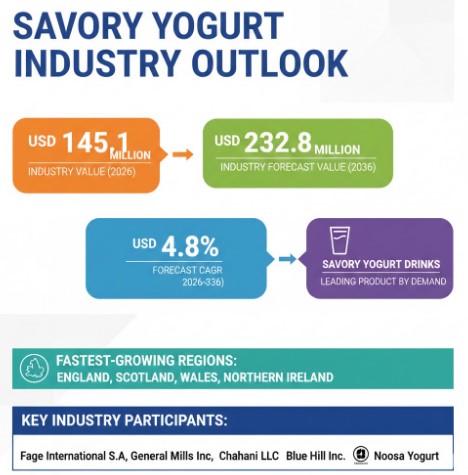
NEWARK, DE, UNITED STATES, January 22, 2026 /EINPresswire.com/ -- Demand for savory yogurt in the United Kingdom is entering a sustained growth phase as consumer eating habits continue to move beyond sweet, breakfast-led dairy consumption. According to updated industry analysis, the UK savory yogurt market is valued at USD 145.1 million in 2026 and is projected to reach USD 232.8 million by 2036, expanding at a compound annual growth rate (CAGR) of 4.8% over the forecast period.
This growth reflects a structural change in how yogurt is used across everyday meals, snacks, and light dining occasions. Savory yogurt is increasingly positioned as a protein-rich, dairy-based component suitable for lunches, shared plates, and cooking applications rather than as a dessert substitute.
Discover Market Opportunities – Get Your Sample of Our Industry Overview Today!
https://www.futuremarketinsights.com/reports/sample/rep-gb-31664
Market Snapshot: Savory Yogurt Demand in the UK
• Industry Value (2026): USD 145.1 million
• Forecast Value (2036): USD 232.8 million
• CAGR (2026–2036): 4.8%
• Leading Product Format: Savory yogurt drinks (36.1% share)
• Primary Sales Channel: Supermarkets (60.0% share)
• Fastest-Growing Regions: England, followed by Scotland and Wales
• Key Participants: Fage International S.A., General Mills Inc., Chahani LLC, Blue Hill Inc., Noosa Yogurt
Why Savory Yogurt Is Gaining Traction in the UK
UK consumers are broadening their definition of yogurt usage, integrating savory formats into daily meals and snacks. Rather than replacing sweet yogurt, savory variants are being adopted for their culinary flexibility, protein content, and compatibility with home cooking. Households increasingly use savory yogurt as a base for sauces, marinades, spreads, and dips, where it delivers creaminess without excessive richness.
Retail acceptance has followed consumer behavior. Savory yogurt is now merchandised alongside dips, spreads, and chilled meal accompaniments, reinforcing its role as a functional food ingredient. Chefs, foodservice operators, and home cooks have contributed to normalization by showcasing savory yogurt in brunch plates, grain bowls, and light dinners.
Product Segmentation Highlights: Drinks Lead Adoption
Savory yogurt drinks account for 36.1% of total demand, making them the most widely adopted product format in the UK market.
Key factors supporting drinkable formats include:
• Convenience for light meals and on-the-go consumption
• Uniform texture that supports herb, spice, and vegetable infusion
• Single-serve packaging aligned with trial and repeat use
• Processing advantages such as stable viscosity and flavor dispersion
Producers favor this format as it allows efficient testing of savory profiles without disrupting established yogurt manufacturing systems.
Supermarkets Anchor Distribution and Repeat Purchase
Supermarkets represent 60.0% of total savory yogurt sales, serving as the primary discovery and replenishment channel. Shelf adjacency to conventional yogurt reduces perceived risk for first-time buyers, while predictable chilled logistics support consistent product quality.
From a supply-side perspective, supermarkets offer:
• Temperature-controlled distribution suitable for fermented dairy
• Predictable volume flow and inventory rotation
• Merchandising environments that encourage repeat purchase
This structure has been critical in moving savory yogurt from niche experimentation toward habitual consumption.
Key Demand Dynamics Shaping the Category
Demand growth is driven by evolving flavor preferences and changing eating occasions, but remains moderated by sensory expectations and pricing sensitivity.
Drivers supporting uptake include:
• Interest in global, umami-forward flavors featuring herbs, spices, and vegetables
• Growth in protein-rich, plant-forward meal occasions
• Foodservice exposure through dips, flatbreads, and shared plates
• Social sharing of recipes and everyday usage ideas
Constraints influencing pace of adoption include:
• High consumer expectations around texture smoothness and seasoning balance
• Sensitivity to price premiums for experimental dairy formats
• Limited production scale for savory variants compared to sweet yogurt
• Retail shelf space decisions driven by localized trial performance
Regional Outlook: England Leads, Others Follow Selectively
Demand for savory yogurt varies by region, reflecting differences in innovation pace, foodservice crossover, and retail trial activity.
CAGR by Region (2026–2036):
• England: 5.3%
• Scotland: 4.7%
• Wales: 4.4%
• Northern Ireland: 3.9%
England leads due to frequent product launches and stronger integration between retail and foodservice concepts. Scotland and Wales show measured expansion through premium and regionally inspired offerings, while Northern Ireland’s growth is tied to focused trial programs and shorter retail cycles.
Competitive Landscape: Culinary Credibility Over Mass Expansion
The UK savory yogurt landscape is defined by cautious innovation rather than rapid mass-market rollout. Buyers and retailers assess products based on texture stability, salt balance, ingredient simplicity, and versatility across cooking and cold applications.
• Fage International S.A. benefits from strained yogurt formats suited to savory positioning
• General Mills Inc. leverages brand scale to test controlled category expansion
• Blue Hill Inc. influences demand through premium, chef-led concepts
• Chahani LLC serves niche and specialty channels
• Noosa Yogurt remains adjacent, with limited direct savory focus
Overall, competitive differentiation centers on culinary relevance, protein texture performance, and consumer education, rather than volume-driven expansion.
Outlook
Demand for savory yogurt in the UK is expected to grow steadily through 2036, anchored in practical usage, flavor balance, and integration into everyday meals. The category’s progress will depend on how effectively producers align sensory quality, pricing discipline, and retail execution with evolving consumer routines positioning savory yogurt as a reliable, meal-adjacent dairy staple rather than a short-term novelty.
Why FMI: https://www.futuremarketinsights.com/why-fmi
Related Reports Insights from Future Market Insights (FMI)
Tempeh Market https://www.futuremarketinsights.com/reports/tempeh-market
Low pH Stable Probiotic Protection Agents for RTD Drinks Market https://www.futuremarketinsights.com/reports/low-ph-stable-probiotic-protection-agents-for-rtd-drinks-market
Salt Perception Enhancing Flavor Modulators Market https://www.futuremarketinsights.com/reports/salt-perception-enhancing-flavor-modulators-market
Spirits Market https://www.futuremarketinsights.com/reports/spirits-market
About Future Market Insights (FMI)
Future Market Insights, Inc. (FMI) is an ESOMAR-certified, ISO 9001:2015 market research and consulting organization, trusted by Fortune 500 clients and global enterprises. With operations in the U.S., UK, India, and Dubai, FMI provides data-backed insights and strategic intelligence across 30+ industries and 1200 markets worldwide.
Sudip Saha
Future Market Insights Inc.
+1 347-918-3531
email us here
Legal Disclaimer:
EIN Presswire provides this news content "as is" without warranty of any kind. We do not accept any responsibility or liability for the accuracy, content, images, videos, licenses, completeness, legality, or reliability of the information contained in this article. If you have any complaints or copyright issues related to this article, kindly contact the author above.
