

Demand for Fruit Snacks in South Korea to Grow USD 363.9 Mn by 2036 as Health-First Consumption Reshape the Snack Market
Demand for Fruit Snacks in South Korea
Expansion in South Jeolla is set to grow at a 6.7% CAGR, driven by cooperative-led, value-added dried fruit production and direct-to-consumer sales.
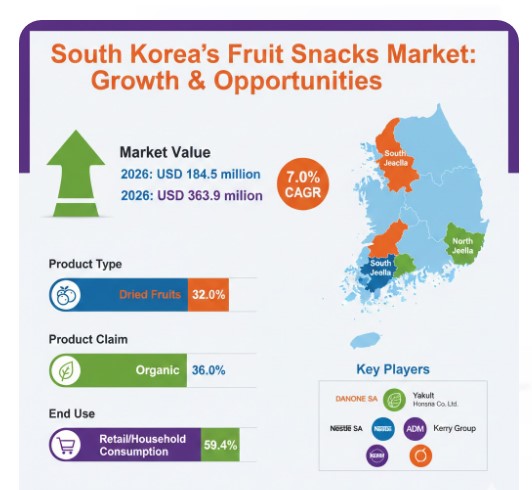
NEWARK, DE, UNITED STATES, January 22, 2026 /EINPresswire.com/ -- Demand for fruit snacks in South Korea is entering a sustained growth phase, driven by changing consumer priorities around health, convenience, and clean-label nutrition. According to the latest market outlook, revenue from fruit snack sales is expected to reach USD 184.5 million in 2026 and rise to USD 363.9 million by 2036, expanding at a compound annual growth rate (CAGR) of 7.0% over the ten-year period.
This growth reflects a structural shift in South Korea’s snack economy, where fruit-based products are increasingly replacing traditional sugar-heavy confectionery across households, schools, workplaces, and retail environments.
Unlock Growth Potential – Request Your Sample Now and Explore Market Opportunities!
https://www.futuremarketinsights.com/reports/sample/rep-gb-31686
Market Snapshot: Demand for Fruit Snacks in South Korea
• Market Value (2026): USD 184.5 million
• Forecast Value (2036): USD 363.9 million
• CAGR (2026–2036): 7.0%
• Leading Product Type: Dried Fruits (32.0% share)
• Leading Product Claim: Organic (36.0% share)
• Primary End Use: Retail/Household Consumption (59.4%)
• Key Growth Regions: Jeju, South Gyeongsang, South Jeolla, North Jeolla
Why Fruit Snacks Are Gaining Ground
South Korean consumers are increasingly aligning food choices with wellness goals. Urban lifestyles, particularly in cities such as Seoul, favor portable, on-the-go nutrition that fits into busy work and study schedules. Fruit snacks—ranging from dried fruits to freeze-dried formats and fruit bars—offer portion control, shelf stability, and perceived nutritional value.
Parents represent a critical demand driver. Growing awareness of ingredient transparency has accelerated preference for products free from artificial additives, pushing clean-label and organic fruit snacks into school lunches and household pantries.
Government policy has further reinforced this shift. Regulatory tightening by the Ministry of Food and Drug Safety on nutritional labeling and sugar disclosure is encouraging manufacturers to reformulate products. Public schools increasingly include fruit-based snacks in meal programs, creating stable institutional demand and reinforcing long-term consumption habits.
Technology and Product Innovation Redefine the Category
Advances in food processing are reshaping both product quality and variety:
• Freeze-drying technologies preserve texture and nutritional content, expanding demand for premium freeze-dried fruits.
• Frozen fruit bar innovations allow for sugar-free formulations that retain authentic fruit flavor.
• Functional fortification, including probiotics, fiber, and vitamins, is blurring the line between snacks and supplements.
• Fruit powders and extracts are increasingly used to enhance nutritional density in bars and leathers.
These innovations enable manufacturers to balance indulgence with functionality, appealing to consumers seeking snacks that support immunity, digestion, and energy management.
Key Consumer Trends Supporting Adoption
Several behavioral trends are reinforcing category growth:
• Rising awareness of plant-based diets and vegan lifestyles
• Increased reliance on better-for-you snacks for weight management and immunity
• Expansion of refrigerated fruit offerings in convenience stores for immediate consumption
• High internet penetration accelerating exposure to new formats such as fruit chips and leathers
This convergence of health consciousness and digital influence is sustaining demand across age groups, particularly among younger consumers.
Segment Analysis: Where Demand Is Concentrated
Product Type: Dried Fruits Lead Consumption
Dried fruits account for 32.0% of market share, supported by cultural familiarity with products such as dried persimmons and jujubes. Modern processing has broadened the category to include mangoes, berries, and citrus slices, offering shelf stability, concentrated flavor, and cost efficiency.
Product Claim: Organic Becomes the Standard
Organic fruit snacks represent 36.0% of demand. Concerns over pesticide residues and chemical inputs are pushing households—especially parents—to trade up to certified organic products. Retailers are responding by expanding dedicated organic sections, improving accessibility and visibility.
End Use: Retail and Household Consumption Dominate
Retail and household use captures 59.4% of total consumption. Supermarkets, hypermarkets, and convenience stores remain the primary sales channels, supported by multipack purchases for families and single-serve packs for office and school use.
Regional Outlook: Growth Varies by Province
Projected CAGR by Region (2026–2036):
• Jeju: 8.4%
• South Gyeongsang: 7.4%
• South Jeolla: 6.7%
• North Jeolla: 5.6%
Jeju leads growth due to strong tourism demand and citrus-based product innovation, while South Gyeongsang benefits from industrial workforce consumption. Agricultural provinces such as South Jeolla are expanding value-added processing through cooperatives, and North Jeolla’s National Food Cluster is driving R&D-led innovation.
Competitive Landscape: Global Scale Meets Local Specialization
The market is led by multinational nutrition companies with strong R&D capabilities:
• Danone SA (30.0% share)
• Nestlé SA
• Yakult Honsha Co., Ltd.
• ADM
• Kerry Group
These firms are integrating fruit snacks into broader health-focused portfolios and securing premium retail placement. At the same time, domestic producers are gaining traction by leveraging local fruit varieties, faster innovation cycles, and direct-to-consumer online strategies.
Outlook
As health policy, consumer awareness, and food technology continue to align, fruit snacks are moving from niche alternatives to mainstream staples in South Korea’s snack ecosystem. With demand projected to double by 2036, the sector represents a structurally resilient growth market shaped by wellness, transparency, and regional innovation rather than short-term trends.
Why FMI: https://www.futuremarketinsights.com/why-fmi
Related Reports Insights from Future Market Insights (FMI)
Cattle Feed Market https://www.futuremarketinsights.com/reports/cattle-feed-market
Fiber-Integrated Fat Mimetics for Dairy Alternatives Market https://www.futuremarketinsights.com/reports/fiber-integrated-fat-mimetics-for-dairy-alternatives-market
Precision Prebiotic Blends for Gut-Brain Axis Support Market https://www.futuremarketinsights.com/reports/precision-prebiotic-blends-for-gut-brain-axis-support-market
Sugar Reduction Mouthfeel Recovery Additives Market https://www.futuremarketinsights.com/reports/sugar-reduction-mouthfeel-recovery-additives-market
About Future Market Insights (FMI)
Future Market Insights, Inc. (FMI) is an ESOMAR-certified, ISO 9001:2015 market research and consulting organization, trusted by Fortune 500 clients and global enterprises. With operations in the U.S., UK, India, and Dubai, FMI provides data-backed insights and strategic intelligence across 30+ industries and 1200 markets worldwide.
Sudip Saha
Future Market Insights Inc.
+1 347-918-3531
email us here
Legal Disclaimer:
EIN Presswire provides this news content "as is" without warranty of any kind. We do not accept any responsibility or liability for the accuracy, content, images, videos, licenses, completeness, legality, or reliability of the information contained in this article. If you have any complaints or copyright issues related to this article, kindly contact the author above.
