

EV Regenerative Braking Control Systems Market Set to Grow from USD 4.6 Billion in 2026 to USD 10.5 Billion by 2036
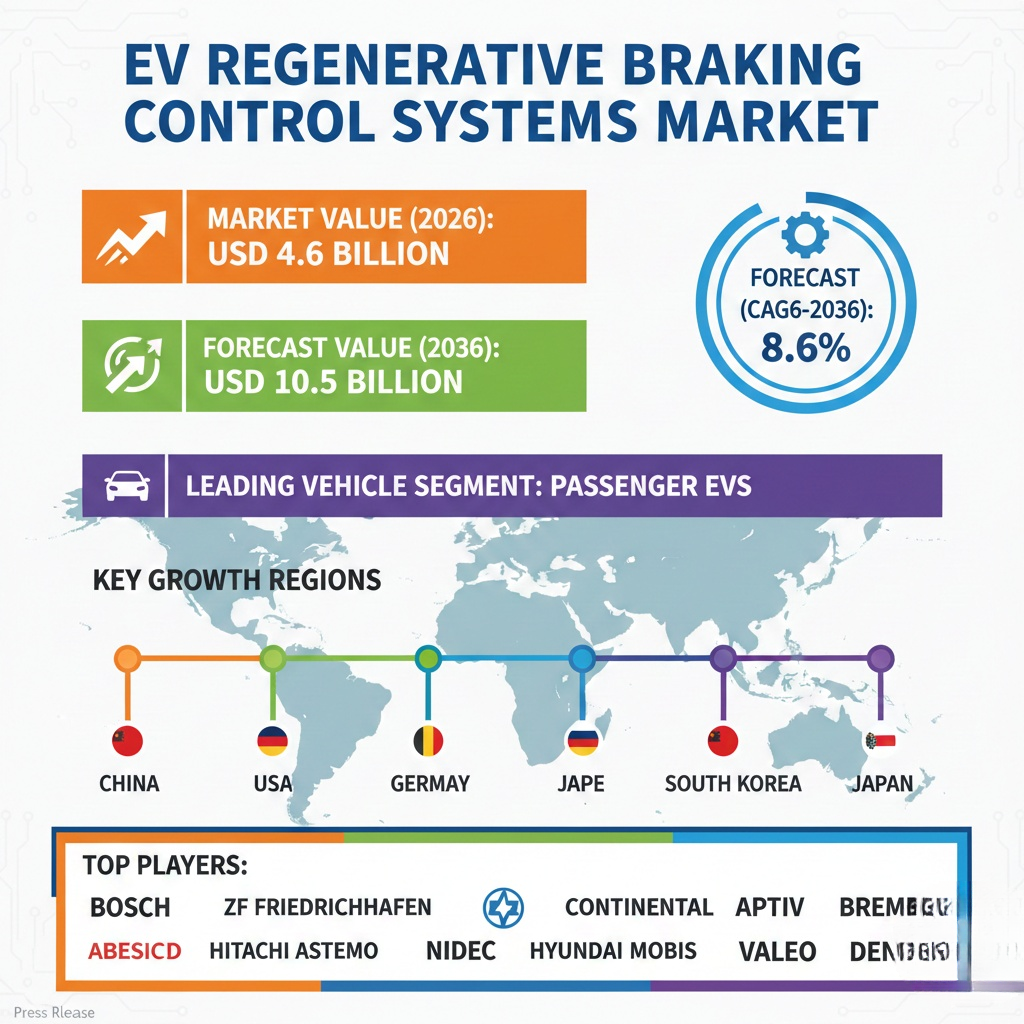
EV Regenerative Braking Control Systems Market
Centralized approvals are driving Germany’s EV regenerative braking market at 7.8% CAGR, efficient energy recovery, safety, and system-wide standardization.
NEWARK, DE, UNITED STATES, January 22, 2026 /EINPresswire.com/ -- The global EV regenerative braking control systems market is entering 2026 valued at USD 4.6 billion and is projected to reach USD 10.5 billion by 2036, expanding at a compound annual growth rate (CAGR) of 8.6%. The market’s trajectory is shaped by electric vehicle platform engineering decisions that place braking control software at the center of energy efficiency, safety validation, and vehicle control integration.
Regenerative braking control systems manage how electric vehicles recover kinetic energy during deceleration while maintaining consistent pedal feel, braking stability, and compliance with safety standards. These systems coordinate traction motors, inverters, friction brakes, stability control, and battery management within a single, safety-critical control layer. As electrified vehicle platforms scale globally, demand for validated, platform-approved control architectures is rising across passenger, commercial, and heavy-duty electric vehicle segments.
Discover Market Opportunities – Get Your Sample of Our Industry Overview Today!
https://www.futuremarketinsights.com/reports/sample/rep-gb-31699
Market Overview: Platform Engineering Defines Adoption
Unlike traditional component markets, participation in the EV regenerative braking control systems market is governed by vehicle platform ownership and homologation cycles. Automakers define control architecture, torque blending logic, and fault-handling strategies during early platform engineering. Once a vehicle platform enters series production, changes to braking control logic require renewed safety and drivability validation, making mid-cycle substitutions uncommon.
As a result:
• Volume growth follows the expansion of electrified vehicle platforms, not short-term sourcing changes
• Revenue development aligns with multi-year supply agreements tied to platform lifecycles
• Competitive positioning depends on early involvement in vehicle control architecture design
Approved systems typically remain in place for the full model cycle, with calibration sets and safety cases tightly linked to specific implementations.
Market Size and Growth Outlook (2026–2036)
In 2026, regenerative braking is already a baseline requirement for most electric vehicles, supporting a market value of USD 4.6 billion. Growth to USD 10.5 billion by 2036 reflects higher software content per vehicle, broader deployment across mass-market EVs, and increasing use of multi-motor configurations.
EV Regenerative Braking Control Systems Market – Quick Stats
• Market value (2026): USD 4.6 billion
• Forecast value (2036): USD 10.5 billion
• Forecast CAGR (2026–2036): 8.6%
• Leading vehicle segment: Passenger EVs
• Key growth regions: China, United States, Germany, South Korea, Japan
Growth during the early 2030s is expected to remain in the mid-to-upper single-digit billions annually as unified brake-by-wire architectures become standard across new EV platforms.
Why Control Systems Matter for Energy Recovery and Safety
Regenerative braking performance depends less on hardware alone and more on the control logic that manages energy recovery, friction blending, and vehicle stability. Automakers evaluate systems on:
• Energy recovery consistency across temperature and battery states
• Predictable pedal response under diverse driving conditions
• Smooth torque transitions between regenerative and friction braking
• Robust fault handling during emergency and low-speed scenarios
Because braking behavior directly affects safety certification, warranty exposure, and brand risk, vehicle manufacturers treat regenerative braking control systems as core safety controllers rather than optional efficiency features.
Passenger EVs Lead Volume Adoption
Passenger electric vehicles account for approximately 62% of total market share, driven by high production volumes and sensitivity to braking feel and deceleration smoothness. For passenger EV platforms:
• Calibration depth and customer acceptance testing dominate development schedules
• Validation costs are amortized across large fleets
• Platform reuse enables volume growth without requalification
Light commercial EVs emphasize durability and predictable braking across load ranges, while heavy-duty EVs focus on redundancy and thermal management under high gross weights.
Integrated Brake-by-Wire Architectures Dominate
Integrated brake-by-wire electronic control units represent about 46% of deployed architectures, reflecting their ability to consolidate blending logic, diagnostics, and actuation control into a single safety-certified unit.
Key advantages include:
• Reduced latency between regenerative and friction braking
• Simplified failure mode containment
• Streamlined software update and validation processes
Once an architecture is selected, OEMs standardize it across multiple models to protect certification timelines and reduce integration risk.
Regional Demand Patterns Reflect Platform Strategies
Demand growth varies by region, shaped by EV adoption rates and platform standardization practices:
• China: 10.6% CAGR, driven by large-scale EV platform replication and fleet expansion
• United States: 8.0% CAGR, supported by expanding EV production programs
• Germany: 7.8% CAGR, guided by centralized technical approval systems
• South Korea: 7.7% CAGR, reflecting strong platform standardization
• Japan: 7.0% CAGR, influenced by rigorous safety verification protocols
In each market, once a system is approved, deployment is standardized across multiple vehicle lines, limiting substitution and reinforcing long-term supplier positions.
Competitive Landscape: Engineering Depth Over Price
Competition in the EV regenerative braking control systems market centers on integration capability, calibration accuracy, and long-term support rather than unit pricing. Leading suppliers include:
• Bosch
• ZF Friedrichshafen
• Continental
• Aptiv
• Brembo
• Hitachi Astemo
• Nidec
• Hyundai Mobis
• Valeo
• Denso
Suppliers are evaluated during extensive vehicle-level validation covering braking torque consistency, energy recovery efficiency, thermal behavior, and fail-safe performance. Once integrated, systems remain embedded across full model cycles.
Market Outlook Through 2036
The EV regenerative braking control systems market is evolving into a foundational layer of electric vehicle control architecture. Growth through 2036 will be driven by higher software complexity, expanding use across all electrified vehicle segments, and long platform lifetimes that lock approved systems into core vehicle designs.
As automakers continue to prioritize range extension, safety compliance, and predictable braking behavior, regenerative braking control systems are expected to remain a critical, platform-defined investment within the global electric vehicle ecosystem.
Why FMI: https://www.futuremarketinsights.com/why-fmi
Related Reports Insights from Future Market Insights (FMI)
Low-Noise Low-Dust EV Brake Components Market https://www.futuremarketinsights.com/reports/low-noise-low-dust-ev-brake-components-market
One-Pedal Brake Control Modules Market https://www.futuremarketinsights.com/reports/one-pedal-brake-control-modules-market
Regenerative Brake Calibration Services Market https://www.futuremarketinsights.com/reports/regenerative-brake-calibration-services-market
Regenerative Braking Optimization Software Market https://www.futuremarketinsights.com/reports/regenerative-braking-optimization-software-market
About Future Market Insights (FMI)
Future Market Insights, Inc. (FMI) is an ESOMAR-certified, ISO 9001:2015 market research and consulting organization, trusted by Fortune 500 clients and global enterprises. With operations in the U.S., UK, India, and Dubai, FMI provides data-backed insights and strategic intelligence across 30+ industries and 1200 markets worldwide.
Sudip Saha
Future Market Insights Inc.
+1 347-918-3531
email us here
Legal Disclaimer:
EIN Presswire provides this news content "as is" without warranty of any kind. We do not accept any responsibility or liability for the accuracy, content, images, videos, licenses, completeness, legality, or reliability of the information contained in this article. If you have any complaints or copyright issues related to this article, kindly contact the author above.
